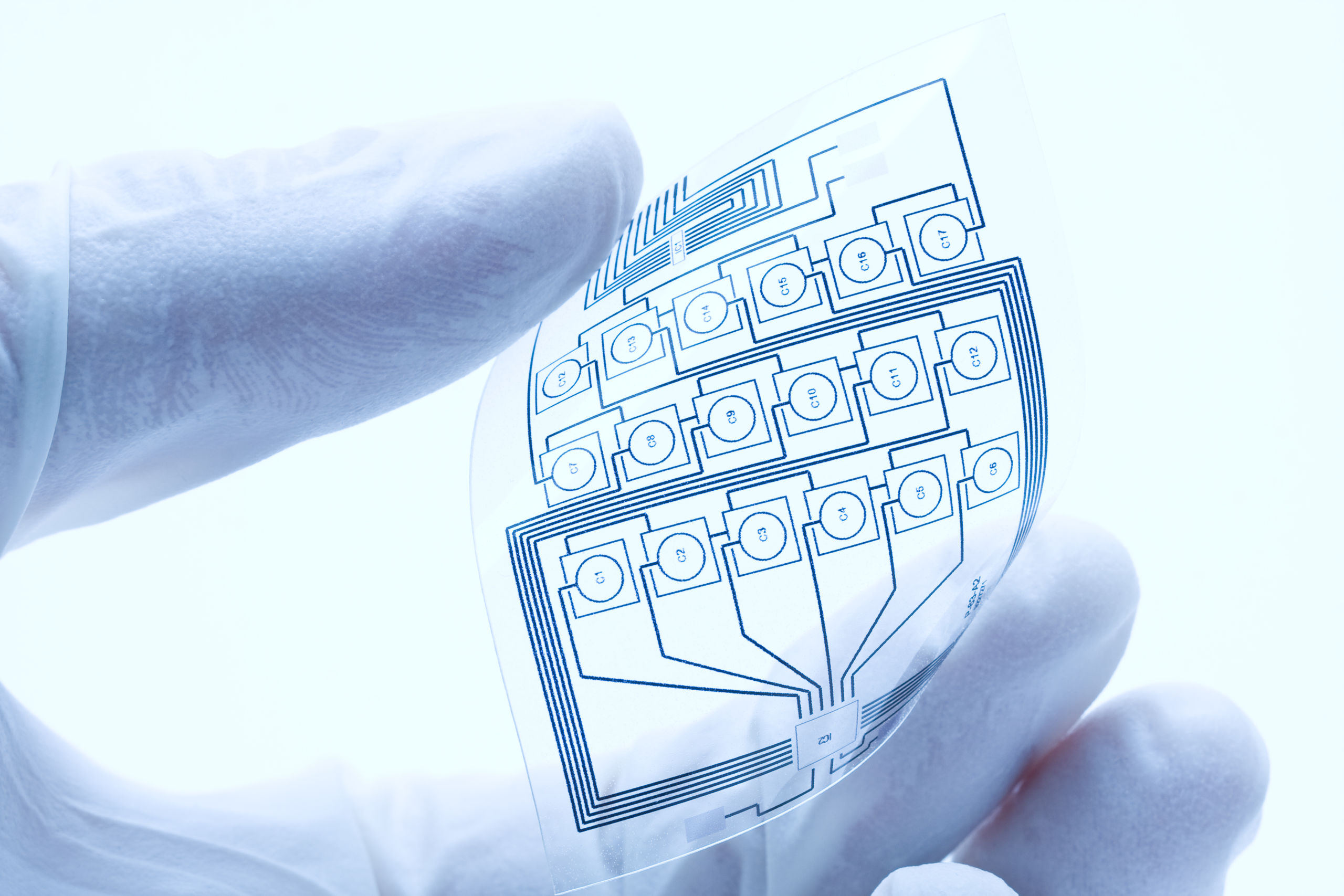
Colorless polyimides (CPIs) are evolving for flexible-display substrates and cover films because they combine the low weight and flexibility of plastics with the thermal and chemical resistance required for electronic device fabrication. Their primary limitation is that conventional aromatic polyimides tend to be yellow or brown. This coloration results largely from charge-transfer interactions between electron-donating diamine segments and electron-accepting aromatic imide structures, which absorb light in the visible region[1].
Many CPI formulations begin with an exotic dianhydride selected for optical performance. Alicyclic, fluorinated, bulky, and noncoplanar dianhydrides disrupt the electronic interactions and close molecular packing that cause conventional polyimides to appear colored. Alicyclic dianhydrides reduce the extent of aromatic conjugation in the backbone, while bulky spiro, norbornane, or bridged ring structures prevent chains from approaching closely. Both effects reduce intermolecular charge-transfer complexes and improve visible-light transmission[2].
Examples include hydrogenated Pyromellitic dianhydride (HPMDA), Cyclohexane-tetracarboxylic dianhydride, and Cyclopentanone bis-spironorbornane tetracarboxylic dianhydride (CpODA). These monomers can yield low-yellowness films because their saturated or three-dimensional structures interrupt the planar aromatic architecture associated with conventional polyimides. Fluorinated dianhydrides such as Hexafluoroispropylidene diphthalic anhydride (6FDA) offer another route. Although 6FDA contains aromatic rings, its bulky bridge and fluorine-rich structure disrupt chain packing and weaken charge-transfer interactions[2, 3].
However, films based only on these transparency-promoting dianhydrides may not satisfy all flexible-display requirements. A highly alicyclic system can provide excellent optical clarity but may have insufficient glass transition temperature, excessive thermal expansion, inadequate modulus, or limited dimensional stability. These limitations become significant during thin-film-transistor fabrication, curing, metallization, and other elevated-temperature steps. Flexible displays also require films that remain flat, resist shrinkage, adhere to adjacent layers, and survive repeated bending[1, 4].
Conventional aromatic dianhydrides are therefore incorporated as performance-building comonomers. Biphenyltetracarboxylic dianhydride (BPDA), Benzophenone tetracarboxylic dianhydride (BTDA®), and Oxydiphthalic anhydride (ODPA) are particularly useful examples. BPDA contributes chain rigidity, thermal resistance, high modulus, and a low in-plane coefficient of thermal expansion. Its presence can help a CPI film retain alignment and dimensional control during device fabrication. BTDA can contribute thermal-mechanical strength, adhesion, and robust film formation. ODPA, through its ether linkage, can improve solubility, coating behavior, toughness, and bend tolerance[4]. The resulting material is usually a copolyimide rather than a polymer derived from one dianhydride.
CPI development uses a molecular division of labor. Exotic dianhydrides provide optical neutrality, while conventional dianhydrides build in stiffness, thermal endurance, adhesion, processability, and CTE control. Adjusting their identity and proportion enables transparent films that also meet flexible-display manufacturing and durability requirements.
Contact your Jayhawk Fine Chemicals representative for support with your next CPI project.
Image: Shutterstock